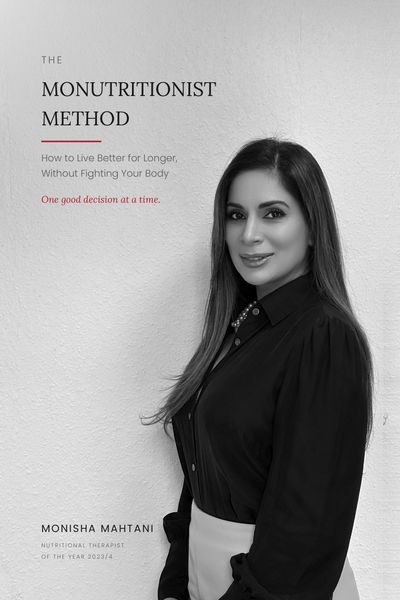
About Monisha
Longevity Lifestyle Strategist
Monisha Mahtani is an award-winning Nutritional Therapist providing personalised targeted nutrition and lifestyle strategy for those seeking long-term health, vitality, and performance. Her work integrates clinical insight with practical implementation, supporting clients globally through private advisory programmes and wellbeing strategy for educational institutions.
Ways to work with Monisha
Private Consultation
Schools and Education (nutritionBAND)
Restaurant Nutrition & Menu Development
Workplace and Organisation Wellbeing
Talks and Workshops



Monisha Mahtani has practised as a fully qualified Registered Nutritional Therapist since 2005. She holds a BA (Hons) in Economics and Politics, a BSc (Hons) in Nutritional Therapy, and postgraduate studies in Public Health from King’s College London (University of London).
She is a member of the British Association for Nutrition and Lifestyle Medicine (BANT) and is registered with the Complementary and Natural Healthcare Council (CNHC), an Accredited Register holder regulated by the Professional Standards Authority for Health and Social Care and accountable to the UK Parliament.
Monisha has worked extensively with clients in the UK and internationally. She lived in Indonesia for 13 years, during which time she was the monthly Health Contributor to Jakarta Java Kini magazine for seven years. She has also spoken on panels including 21st Century Wellness at the Bett Education Show at London ExCeL.
Alongside her clinical nutrition work, Monisha is an IFPA-approved Personal Trainer (since 2010) and a certified meditation teacher. She integrates movement, breathwork, and nervous-system regulation into her practice, drawing on formal training in health, fitness, and applied movement. This approach underpins Movement Bites™ by Monutritionist™ — short, strategic practices that combine motion, breath, and awareness to support metabolism, resilience, and longevity. Monisha has also studied positive psychology at the University of California, Berkeley, integrating evidence-based lifestyle and mindset tools into her advisory approach.
She is the founder of nutritionBAND®, a wellness education and awareness platform for parents, students, and teachers, and SKINutritional®, a natural range of skincare oils rooted in skin nutrition and longevity principles.
Monisha is featured in the Tatler Address Book and is the recipient of multiple industry awards, including Nutrition & Wellness Winner at the SHE Awards (2023) and Nutritional Therapist of the Year at the Prestige Awards 2023/2024 (London & South East England).
Out Now!
The MONUTRITIONIST™ Method
How to Live Better for Longer, Without Fighting Your Body. One good decision at a time.
Buy the paperback — £16.99.
This Website Amazon UK Amazon US Amazon Australia Amazon De Amazon Fr Amazon Es
Amazon It Amazon NL Amazon Pl Amazon Se Amazon Be Amazon IE Amazon JP Amazon Ca
Most people are not short of health information. They are overwhelmed by it. Conflicting advice, constant optimisation and the pressure to get everything right have turned health into something exhausting. What has been missing is a structure that fits the life you are actually living. After more than two decades in clinical practice, I kept seeing the same pattern. Capable, disciplined people, following sound advice, and wondering why it wasn't working. "It usually wasn't them. The advice was built for a different phase of life than the one they were in."
The MONUTRITIONIST™ Method is a framework, not a plan. It rests on four pillars, and on how they interact:
Nutrition as biological signalling
Gut health as the body's central regulator
Movement, breath and nervous system regulation
Targeted support, matched to your life stage
Each pillar strengthens the others. Support one and the rest become easier — which is why the Method compounds over years where single changes fade within weeks.
Written for women and men in midlife and beyond — including the phases most health books skip.
If you have followed good advice and found it didn't hold, this book starts from a different assumption: that the problem was rarely your discipline, and usually the fit.